

Nieuws


0 reacties

46x viewed
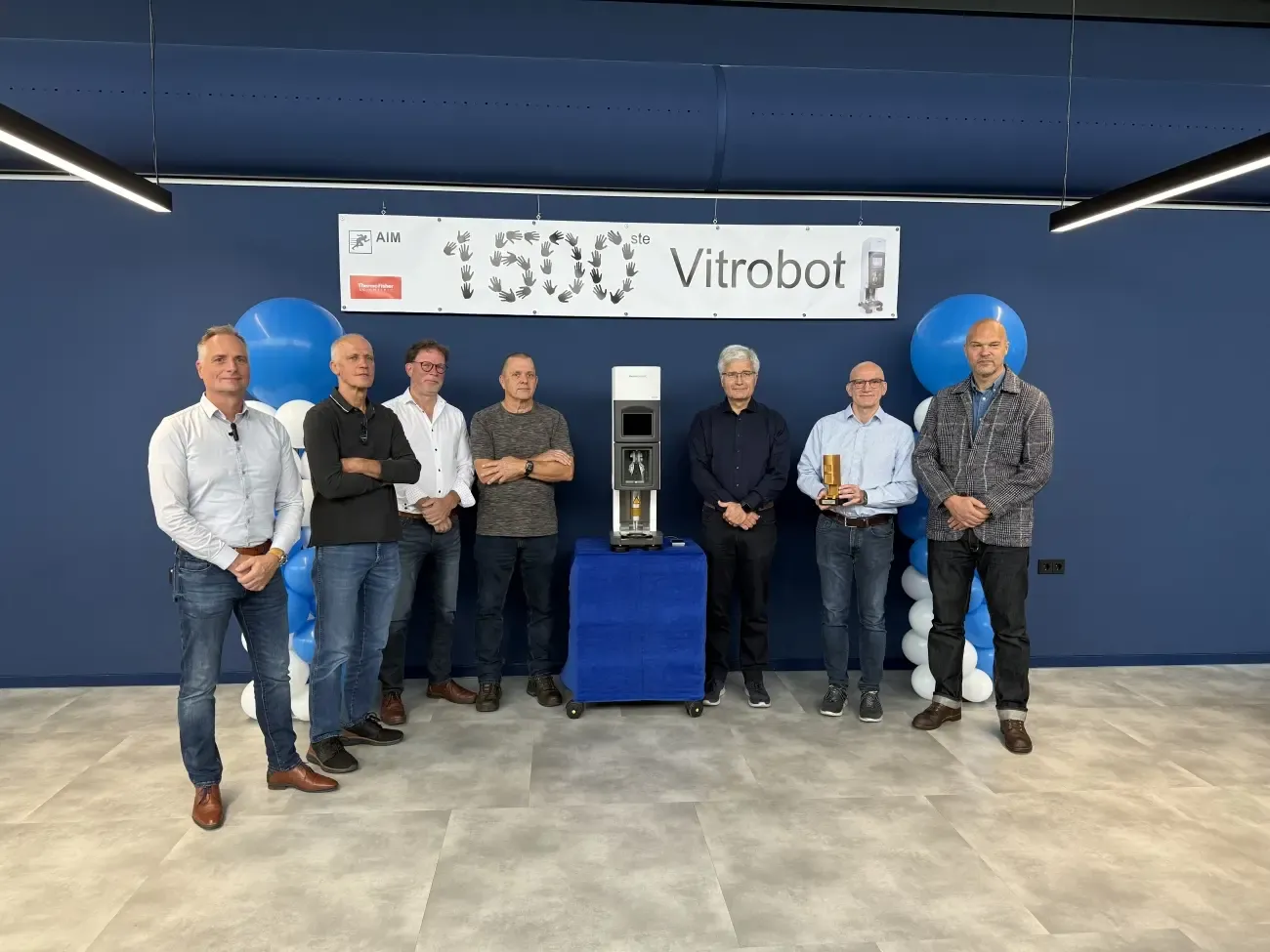
Hurrah! Recently, the 1500th Vitrobot was built. This extraordinary device helps scientists better understand diseases such as Alzheimer's and covid-19. The Vitrobot is now in hundreds of laboratories worldwide, but its roots are just here - at Brightlands Maastricht Health Campus.
From Crafts to High-Tech
Scientists want to see very precisely what proteins, cells and viruses look like. They do this with a special microscope, the cryo-EM. To do this, they must first freeze their samples. Until the mid-1990s, this was done by hand: time-consuming and difficult, with often inconsistent results. That had to be improved.
In 1996, two Maastricht researchers, Peter Frederik and Paul Bomans, together with engineer Paul Laeven, developed a clever alternative: the P3, predecessor of the Vitrobot. The device freezes biological specimens under a wafer-thin layer of glass ice. This keeps them stable and allows razor-sharp images to be made of them.
A golden opportunity
.To develop the invention further, Maastricht Instruments (MI) stepped in. Because MI itself had no serial production capacity, AIM B.V. in Brunssum was called in. Together, the Vitrobot was further developed and put into production. The devices quickly found their way to universities and research centers around the world. The success also caught the attention of Thermo Fisher Scientific, which acquired the exclusive rights to market the Vitrobot worldwide in 2002.
History of the Vitrobot
.- 1996: First prototype (P3) developed at Maastricht UMC+ .
- 2000: First sale of Vitrobot by Maastricht Instruments
- 2002: Exclusive license with Thermo Fisher Scientific and collaboration with AIM B.V.
- 2007: 100th Vitrobot in production
- 2020: Deployment during corona pandemic
- 2025: 1500th Vitrobot produced in Brunssum
Further development in Brunssum
.The first editions of the Vitrobot still worked with compressed air, which made a lot of noise in the lab at the time. Over the years, MI and AIM developed a new model: quieter and with a rounder, friendlier design. Still, many researchers are still wedded to their older edition, says Emile Arnoldussen of AIM.
The latest Vitrobot is assembled here in 28 hours by three mechanics. More than half of the 50 employees at AIM are involved with the device in some way: from procurement to assembly and from service to repairs.
World-wide impact
The Vitrobot also made a name for itself worldwide. A specimen frozen with the device even made it to the cover of the leading magazine Nature. This caught the attention of Thermo Fisher Scientific, which has since been closely involved in its further development and worldwide distribution.
During the corona pandemic, the Vitrobot played a key role in unraveling the virus. It also accelerated research into the origins of Alzheimer's. What used to take 20 years now works in a few months: thanks to the Vitrobot, vaccines are developed faster and diseases are better understood.
Facts & figures
.- To be found in more than 350 labs worldwide
- More than 100 devices produced annually
- 28 hours of construction time per device, by a team of 3 mechanics
- AIM employs 50 people, of which more than half are involved with the Vitrobot
From local idea to world standard
What once began as a clever idea by three researchers has become the standard in labs around the world. And at the same time, the Vitrobot remains firmly rooted in Limburg soil. Its success shows what can happen when researchers and companies on campus and in the region decide to work together. It is perhaps the best proof that great innovations often start small and close by.