Nieuws


0 reacties

68x viewed
By Brightlands Smart Services Campus
The ELSA Lab Poverty & Debt is developing with HIP, a tool that makes letters understandable without losing legal validity. HIP stands for Clear, Intelligent and Productive and was developed in partnership with Brightlands Smart Services Campus, PNA Group.
An AI solution with a social mission
.How can artificial intelligence contribute to a society free of poverty and problematic debt?
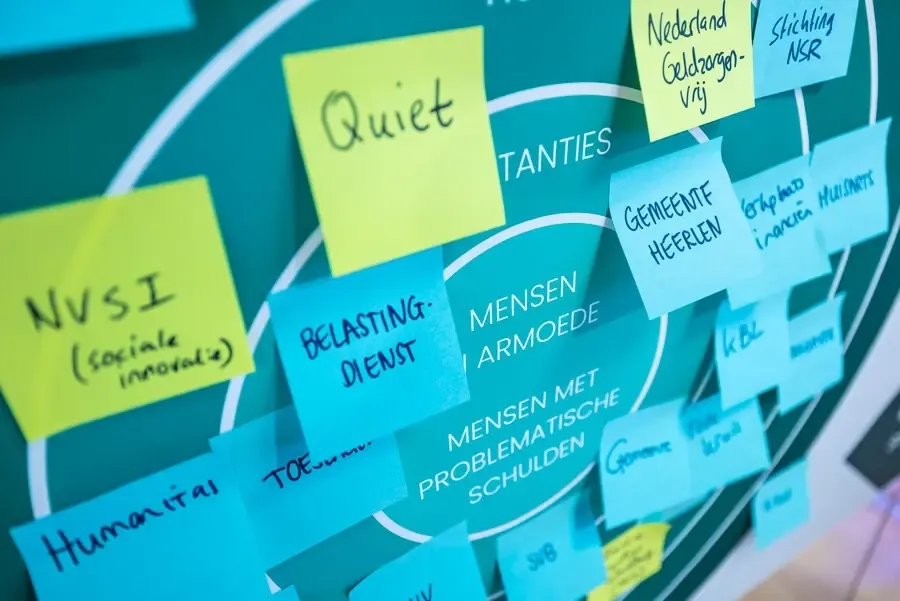
That is what the ELSA Lab Poverty & Debt, a collaboration between the Brightlands Smart Services Campus with knowledge institutions, governments, businesses and citizens, is investigating.
ELSA stands for Ethical, Legal and Societal Aspects of AI. Within the lab, partners work together on technological innovations that support people living in poverty.
In this series, we highlight some of those AI solutions, from more understandable government communications to smarter debt relief: tools with a mission to alleviate poverty and debt.
A government letter in HIPpe language
.Do you remember it, OHRA's commercial about the purple crocodile? A girl wants to pick up her lost inflatable crocodile, which she clearly sees behind the counter. But it doesn't happen that quickly: a form has to be filled out, an appointment has to be made ...
That crocodile from 2021 became the symbol for slow, inaccessible government communication. But has anything really changed since then?
Government letters contain so many difficult words that halfway through you think, "wait, what do they really mean?"
.
That leads to stress, misunderstanding and missed appointments.
And those already struggling to make ends meet sometimes get into even more trouble.
Nadine Beks van Raaij found that unpalatable. During her master's in Data Science at the Jheronimus Academy of Data Science (JADS), she investigated whether artificial intelligence could help the government communicate more intelligibly - without losing the legal meaning.
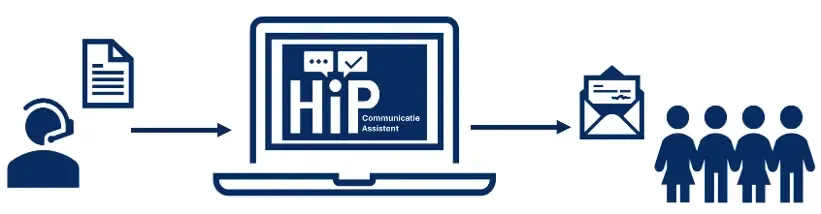
The result: the HIP Communication Assistant, a digital assistant for civil servants who want to write letters that people do understand
.Go with the purple crocodile, on to 100% understanding
During her research in 2023, Nadine had 72 people from different backgrounds and education levels read government letters, alternating between the original form and a simplified version.
The results were striking: understanding of the text increased from 66 percent to more than 90 percent. That means that many government letters are still only just over half understood - but HIP shows that it can be done differently.
How HIP makes a difference
HIP is an online service that helps government employees write accessible letters. 'Suppose you are a civil servant and you are in doubt whether your text is understandable enough,' explains Nadine. 'Then you paste the text into the HIP environment and let the assistant look at it with you.'
The assistant helps employees in three ways:
- Automatically detects personal data so it can be easily deleted.
- Simplifies the text and formulates shorter, more understandable sentences.
- Adds a glossary at the bottom of the letter that explains difficult terms such as Wmo, pgb or objection in plain language.
- Simplifying letters is particularly important for people in poverty or debt, because they receive above-average amounts of government letters.
Accessible letters prevent misunderstandings and help citizens take action to get out of poverty more quickly.
Before and after HIP
The HIP Communication Assistant makes texts understandable, while maintaining legal validity.
Before:
"If, in view of the provisions of the Social Support Act 2015, you believe that you are eligible for a customized facility, you must submit a reasoned application to the Municipal Executive for this purpose, accompanied by the necessary supporting documents."
After:
"Do you think you are entitled to help from the Wmo? Then you can make an application to the municipality.
Write in your letter why you need help and include evidence, for example from your doctor.
.WMO = The Social Support Act ensures that people can continue to live independently and participate in society as long as possible.
The municipality can help with this, for example with domestic help, a wheelchair, transportation or a home modification such as a stairlift."
Made & Saved in Limburg
HIP has many advantages over other Large Language Models, such as ChatGPT.
'The servers are in the Netherlands, so there is no data going to America, for example. Many government organizations find that crucial,' Nadine says.
'With many generic AI tools, you never know where your data will end up and whether it will be used for training models. Here, everything stays local and secure.'
HIP is currently being further developed in collaboration with GPT-NL, the Dutch language model built entirely from Dutch data sources.
And the future of HIP?
The tool currently works through a Web browser. 'That's convenient, but not perfect yet,' Nadine says. 'Many municipalities work in Word or Outlook, so we are now investigating how we can integrate HIP directly into that.' She hopes more municipalities will join the pilot in the future. 'And we are working together on GPT-NL, a Dutch language model developed using only Dutch data, to also teach this model how to simplify a government letter.'
Human remains in control
Although Nadine works with AI on a daily basis, she is convinced that humans should always remain in control:
"AI should never make decisions on its own, but it can help tremendously. By aggregating information, creating overview and ensuring that less is overlooked."