
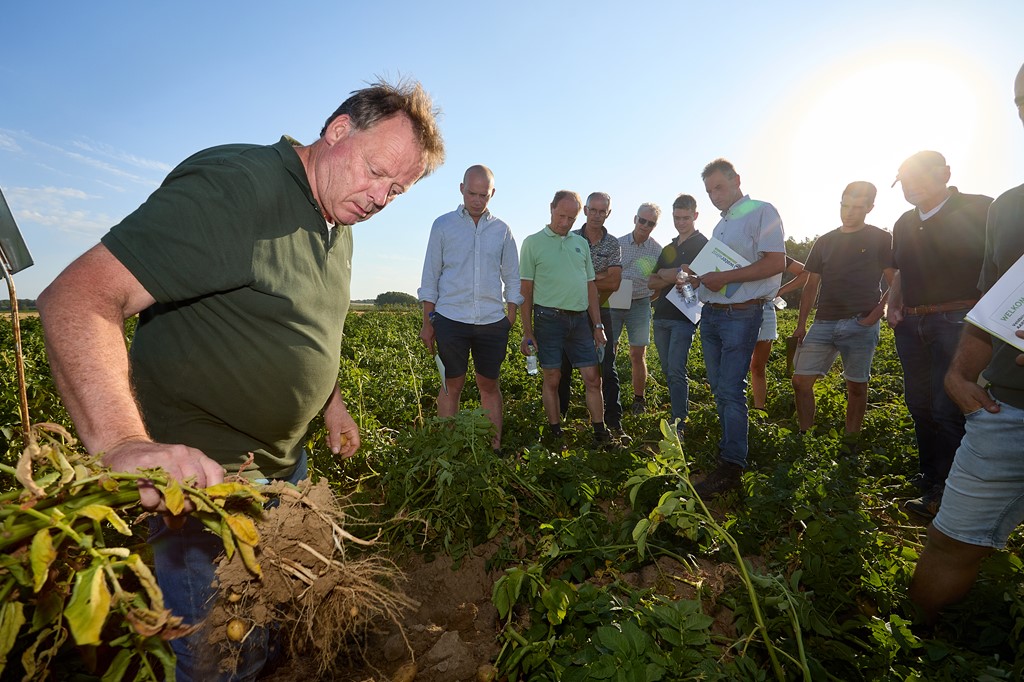
 Foto: LLTB
Variety trial aims to prepare South Limburg’s potato cultivation for the future
31 July | Toekomst, Healthy | LLTB
The landscape for potato cultivation is changing. Summers are becoming warmer and drier, whilst nitrogen fertilisation standards are becoming stricter. How can growers on the loess soils of South Limburg continue to grow potatoes profitably in the future? A demonstration at the Wijnandsrade Experimental Farm aims to provide guidance on this. Growers were brought up to speed during a field meeting.
Guido Schriever does not mince his words: a change of course is needed in potato cultivation. ‘We cannot continue to grow potatoes the way we always have. The recent spell of hot weather has made that clear once again,’ says the LLTB project leader. ‘If a potato variety is not sufficiently resistant to drought and heat, yields plummet and the nitrogen applied is not absorbed effectively. We must therefore look for varieties that are more resilient to the changing climate and use nitrogen as efficiently as possible. Under the 8th Nitrates Directive Action Programme, nitrogen fertilisation standards are being further tightened.’

Demo featuring five breeds
Against this backdrop, a variety trial was set up this spring at the Wijnandsrade Experimental Farm. This is part of the WaterWinst programme, in which the LLTB is working with other organisations to optimise soil and water management. The Fontana variety and the new varieties Lugano, Donata, Chenoa and Castor are being tested. ‘We are looking for robust varieties that perform well in high temperatures and with limited water, and which have low nitrogen requirements. In the trial, we are testing two levels of nitrogen application: 120 and 150 kilograms per hectare. That is considerably less than usual.’
No firm conclusions yet
During a field meeting on 14 July, growers were briefed on the set-up of the variety trial. A biostimulant trial and a trial focusing on PFAS-free potato cultivation were also explained. ‘We explained to those present what the trial involves,’ says LLTB project leader Wiebke Neddermann. ‘It was still too early to present any results. You can, however, see that the varieties are reacting differently to the extreme drought. This is because we are not irrigating. It is still too early to say much about the impact of the nitrogen levels used.’
Schriever points out that nitrogen measurements in the soil and in the leaves do correspond to the nitrogen application rates. ‘In other words, you can see the difference between 120 and 150 kilos clearly reflected in the soil and the leaves. Leaf sap analyses also show that there are differences in nutrient uptake between the varieties.’
Pushing boundaries
A follow-up meeting will take place on 13 August, at which the initial results of the trial will be presented. Schriever emphasises that the findings of the trial are of great importance to the South Limburg potato sector. ‘We hope this will provide guidance on how to continue growing potatoes profitably in the future. Growers are not always fully aware of the need to do things differently. They wonder why we are pushing things to the limit, rather than giving the crop more leeway. But it is vital that we prepare for the challenges of the future. It is only by pushing boundaries that you gain new knowledge and make progress. In short: potato growers, make sure you’re there on 13 August!’