
Growing despite a congested power grid
23 October | Duurzaam | Crossroads
Becoming more sustainable, expanding and innovating: as an entrepreneur, you want to move forward. But across the Netherlands, and in North Limburg too, businesses are literally coming up against a limit: the electricity grid is at full capacity.
Whilst many business parks are struggling, the municipality of Peel en Maas is working on a local solution. In an energy hub, businesses share the electricity they generate with one another. The initiative demonstrates how collaboration can create opportunities to grow and become more sustainable, despite grid congestion.
Necessity as a driving force for innovation
The impetus for the energy hub at the Panningen industrial estate was an urgent need from the industry. Engels Brickworks, a fourth-generation family business, must reduce its CO₂ emissions by 20 per cent by 2030 to comply with European regulations. However, the plan to build an electrolyser for hydrogen production ran into difficulties due to a lack of grid capacity: a standard grid connection is simply not available in the coming years and would involve high costs.
The solution turned out to be right on the doorstep. By laying a four-kilometre direct cable from the nearby Egchelse Heide Wind Farm to the factory, the green electricity generated can be drawn directly. What began as a solution for a single factory has now grown into a wider initiative. A future solar park, De Schorf, also wishes to connect to this network. In addition, greenhouse growers, transport companies such as DHL and parties involved in a potential expansion of the industrial estate have expressed an interest.

To further develop this local solution, the consultancy firm GreenTrust Consultancy has joined the project. Director Jeroen Boerkamps is leading the project and guiding the parties involved in the development of the Egchelse Heide energy hub. According to him, the local sharing of electricity offers great potential, but also requires a pioneering spirit and far-reaching cooperation.
This is where Crossroads Limburg’s role as a facilitator comes into play. In Peel en Maas, energy producers, businesses that require energy, and technical and legal experts need to be able to find one another. Crossroads Limburg brings the right people together so that they can work out how the plans and energy requirements align.
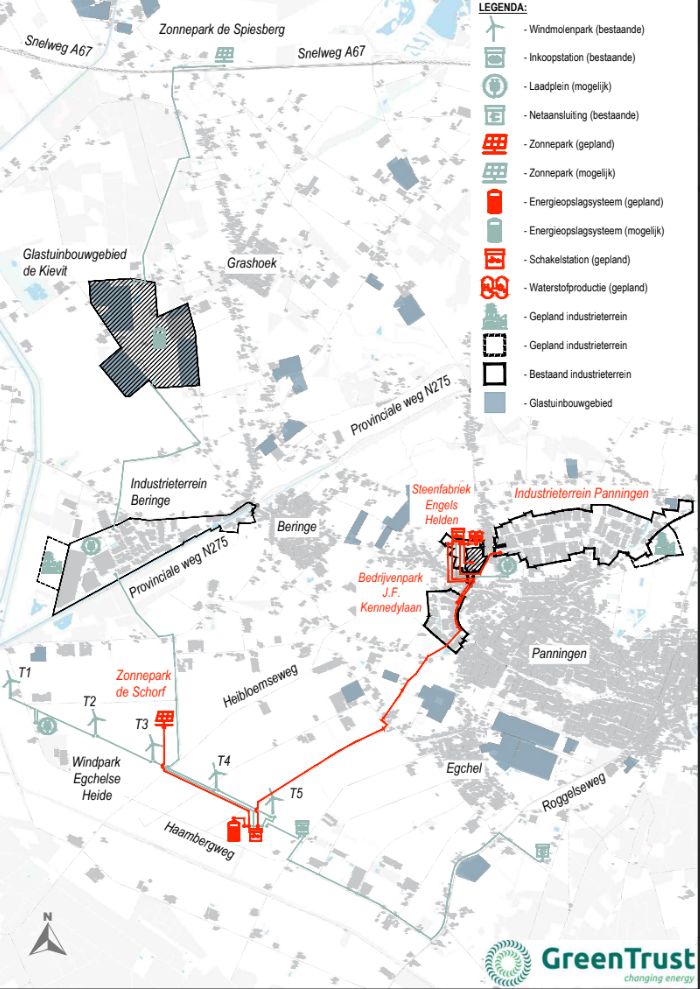 Overview of existing and potential energy assets around the Egchelse Heide energy hub in Peel en Maas. Source: GreenTrust.
Working with the government
Whilst companies are now well connected with one another, regulations often still prove to be a constraint. For example, companies are not permitted to install a second electricity connection on a plot of land where a low-voltage connection is already in place. Furthermore, from a legal perspective, a ‘cable pooling’ arrangement may only have a maximum of four own allocation points (EAN codes). This calls for creative legal solutions and plot layouts.
Cooperation with public authorities is therefore also important. In practice, Jeroen has noticed that innovative solutions sometimes clash with existing frameworks and regulations. To get projects such as this energy hub off the ground more quickly, there is a need for public authorities to engage constructively and flexibly in the process. Crossroads Limburg can also bring parties together in this regard, so that the needs of the regional business community and the possibilities within the regulatory framework can be discussed jointly.
Looking ahead: come together as entrepreneurs
For businesses that are currently facing, or will face in the future, grid congestion, the message is clear: don’t wait and see. The problem is not going to be resolved any time soon, and the costs associated with the electricity grid will only continue to rise in the coming years. A business connection already costs hundreds of thousands of euros a year, purely for the connection fee. By sharing electricity locally via a direct cable, businesses can avoid these high network costs.
Over the coming period, it will become clear whether there is sufficient interest and whether the energy needs of businesses are compatible. If the technical, legal and financial conditions also prove to be feasible, an energy hub could create scope for further growth and greater sustainability. The first step is to identify needs, bring parties together and explore the possibilities jointly.
By joining forces, sharing investments and working together within an energy hub, you, as an entrepreneur, retain control over the growth and sustainability of your own business.