
 Foto: Provincie Limburg
Eager to learn more about the world of the Einstein Telescope
26 October | Toekomst | Provincie Limburg
On the afternoon of Wednesday 21 October, around 250 curious visitors to the Einstein Telescope Experience at the Nieuwe Nor in Heerlen were immersed in the world of the Big Bang, black holes and gravitational waves during presentations and interactive workshops.
That curiosity about how the world works is timeless and has brought humanity many benefits, as science journalist Diederik Jekel, physicist Gideon Koekoek of Maastricht University and cosmologist Thomas Hertog illustrate in a vivid and enthusiastic manner. And with every new insight, a mystery box on stage was opened bit by bit, just as the universe slowly reveals its secrets.
“As a new-generation instrument for measuring the universe, the Einstein Telescope is not just a treat for scientists, but for all of us,” physicist Gideon Koekoek assures visitors at the free public event, the Einstein Telescope Experience, organised by the Province of Limburg. “Of course, the Einstein Telescope is all about science, but it’s just as much about the new technology involved in its development and construction, and ultimately about society too. Because take it from me, we’re going to make discoveries that we can’t even begin to imagine right now, and which will help us move forward as a society.”

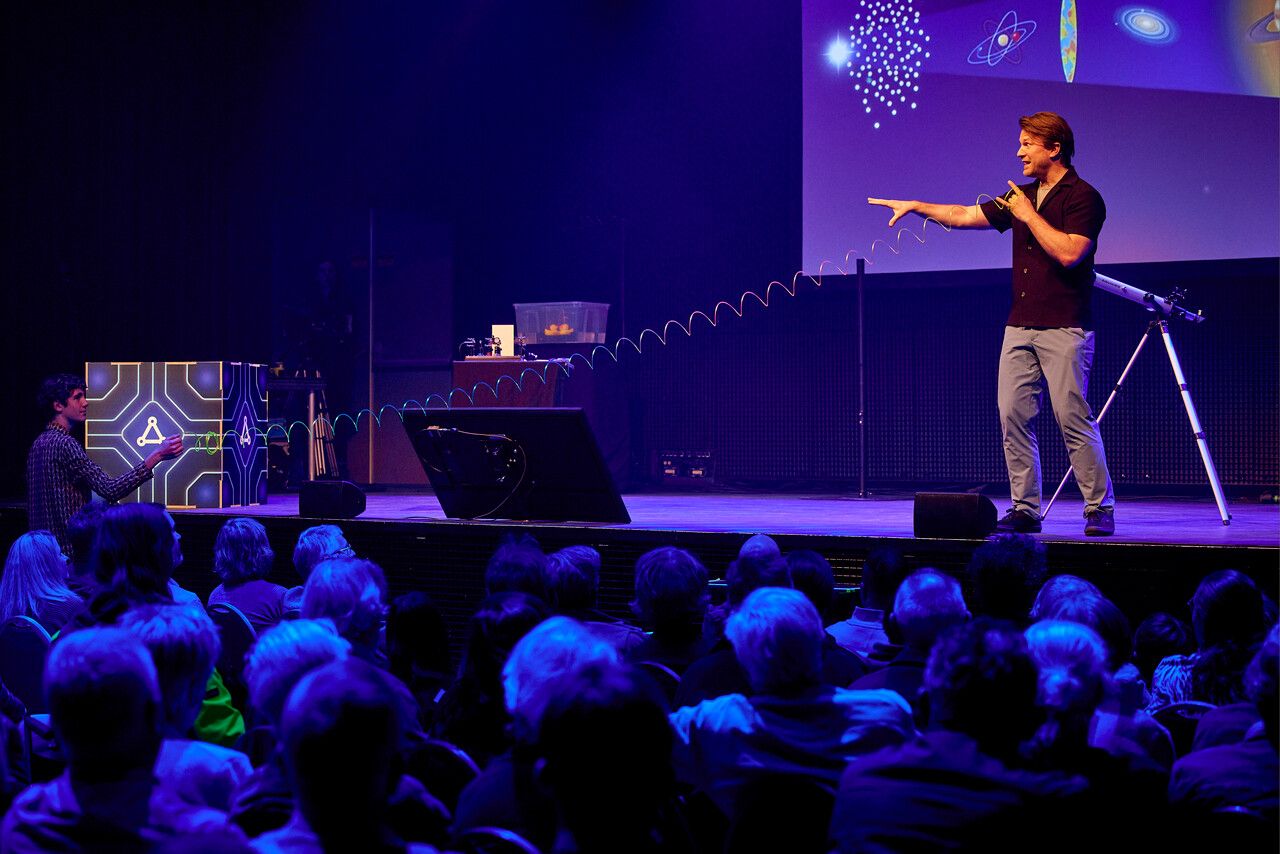 Foto: Provincie Limburg
Wanting to understand the world
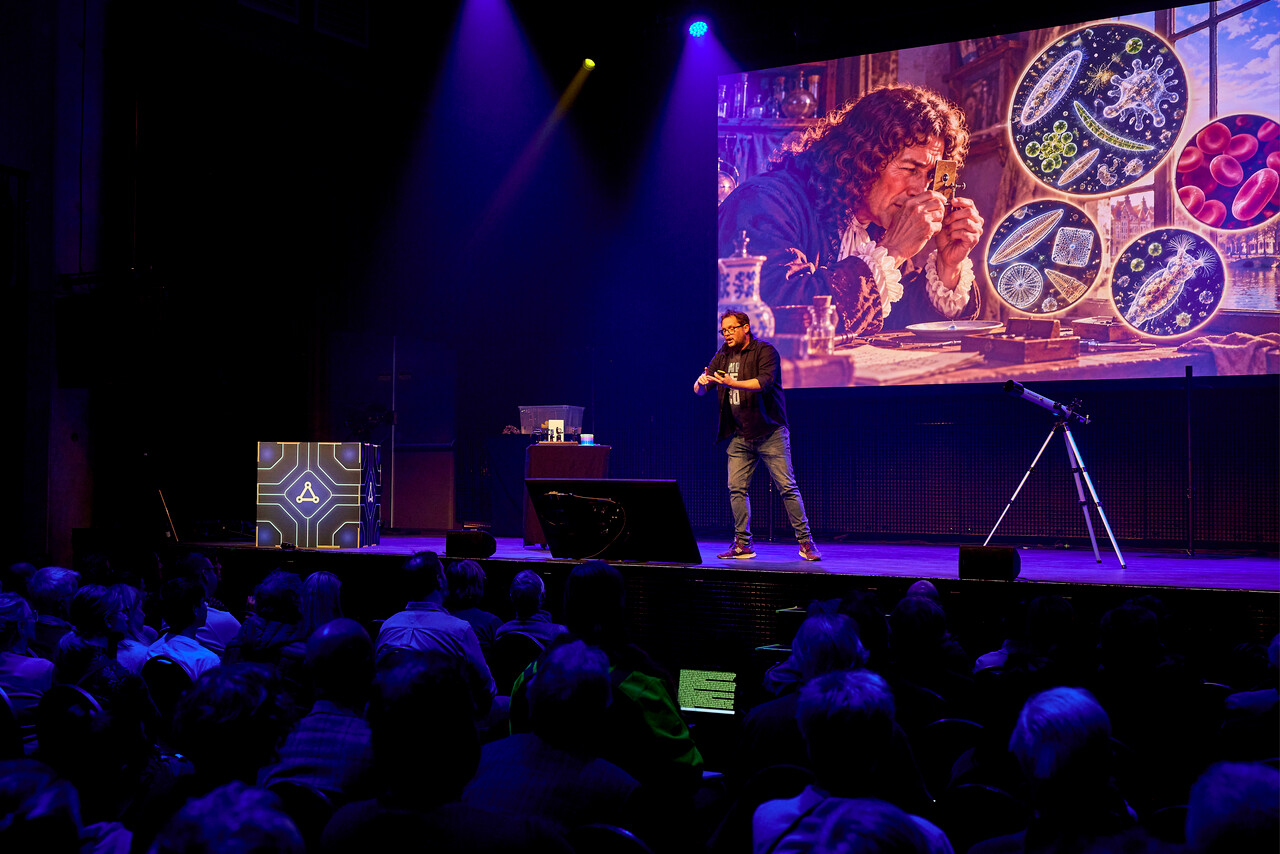
Diederik Jekel begins by taking the audience – from young people to those a little older – on a journey to ancient Egypt, where they discovered that the starry sky followed a certain rhythm. “They were curious about the movement of the stars and wanted to understand how the world around them worked. They realised that the universe functioned like a clock, signalling periods of drought and abundance. A curiosity that led to bountiful harvests.”
That same curiosity led to the invention of the telescope in the early 17th century. Jekel explains how Hans Lippershey, a spectacle-maker from Zeeland, invented the telescope and thereby made the invisible visible. “Suddenly, things became visible that people had never seen before, such as bacteria. Just imagine: the very first glimpse of a piece of bread under a telescope. The shock of seeing all the movement inside it. This completely transformed our view of the world.”
Just as in 1915, when Albert Einstein’s theory of relativity transformed the physicists’ view of the universe. Jekel: “The prevailing view was that space was nothing, but Einstein said: space itself is also something. It has properties and influences the stars, planets and all matter in the universe. It holds everything in place. And that is what the Einstein Telescope will measure: gravitational waves that will give us yet another perspective on space.”
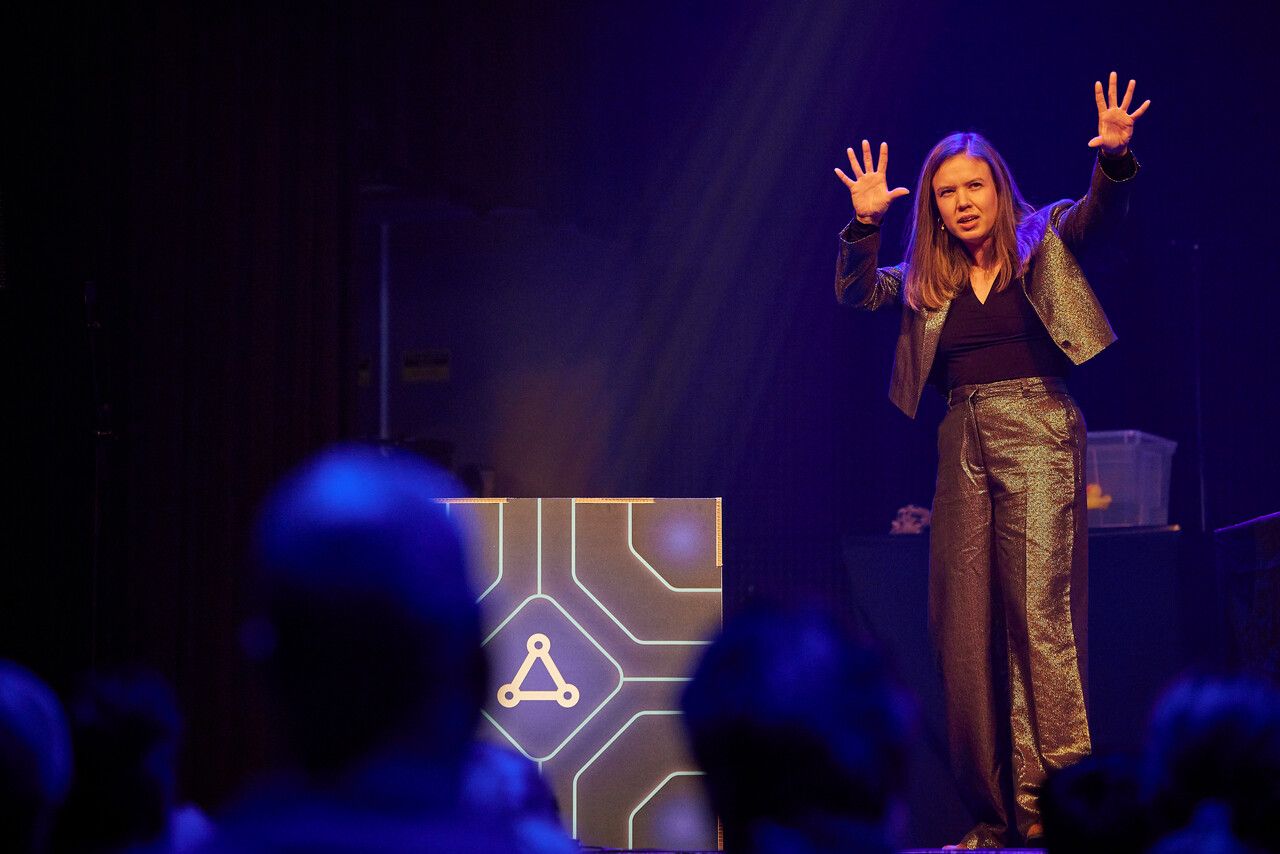 Foto: Provincie Limburg
Measuring the wobble of the universe
“Why would you explore the universe using just one sense – namely, looking through telescopes?” continues physicist Gideon Koekoek during the plenary session of the Einstein Telescope Experience. “By listening and measuring gravitational waves, we will gain a better understanding of how the universe works. But how do you measure the wobble of the universe?” Using rubber ducks in a water tank and the movement of a metal spiral, he demonstrates how ripples in space work and can be calculated. He also explains how the Einstein Telescope will take measurements underground using laser beams and mirrors over vast distances, so that even the slightest ripple can be detected.
“There’s a good chance we’ll be surprised by what we discover. The universe is also a vast history book in which we can look back at the past. The only thing is, there’s a limit to what we can see. It’s impossible to see the Big Bang, but measurements of gravitational waves can make it visible.”
The search for the origins of the forces of nature
“The Einstein Telescope is set to bring about a Galilean revolution in science,” says cosmologist and physicist Thomas Hertog as he begins his keynote speech on the Big Bang, referring to the improved telescope developed by Galileo Galilei in 1609, with which he proved that the planets revolve round the Sun. “Over the past 400 years, we have built up a magnificent picture of the universe, but it is still a very limited one. Most of the matter consists of dark matter and dark energy. So there is much we do not know. With the Einstein Telescope, we will go further than was ever possible before.”
Hertog explains how Albert Einstein’s theory of relativity centres on the interaction between space and time on the one hand, and matter and energy on the other. He also explains how the Belgian priest Georges Lemaître calculated, at the beginning of the last century, that the expanding universe is contracting towards the past. Hertog poses the question of all questions, put forward by the physicist Stephen Hawking, with whom he has worked: ‘The universe seems to have been designed. Why is it the way it is?’ Ultimately, it is all about the quest to discover the origin of all the forces of nature.
Curiosity: the key to answers
Visitors were able to discover and learn to measure these forces of nature through interactive experiences in various rooms at the Nieuwe Nor. From a workshop on stardust to building an interferometer, and from simulating test drilling in a sandpit to a film about black holes. All driven by curiosity. And that, concluded Yvonne Smit, chair of the day’s proceedings and science communicator for this Experience, is the key to finding answers. After all these insights, the mystery box opened fully and the keyring popped out – which all visitors were able to take home with them.
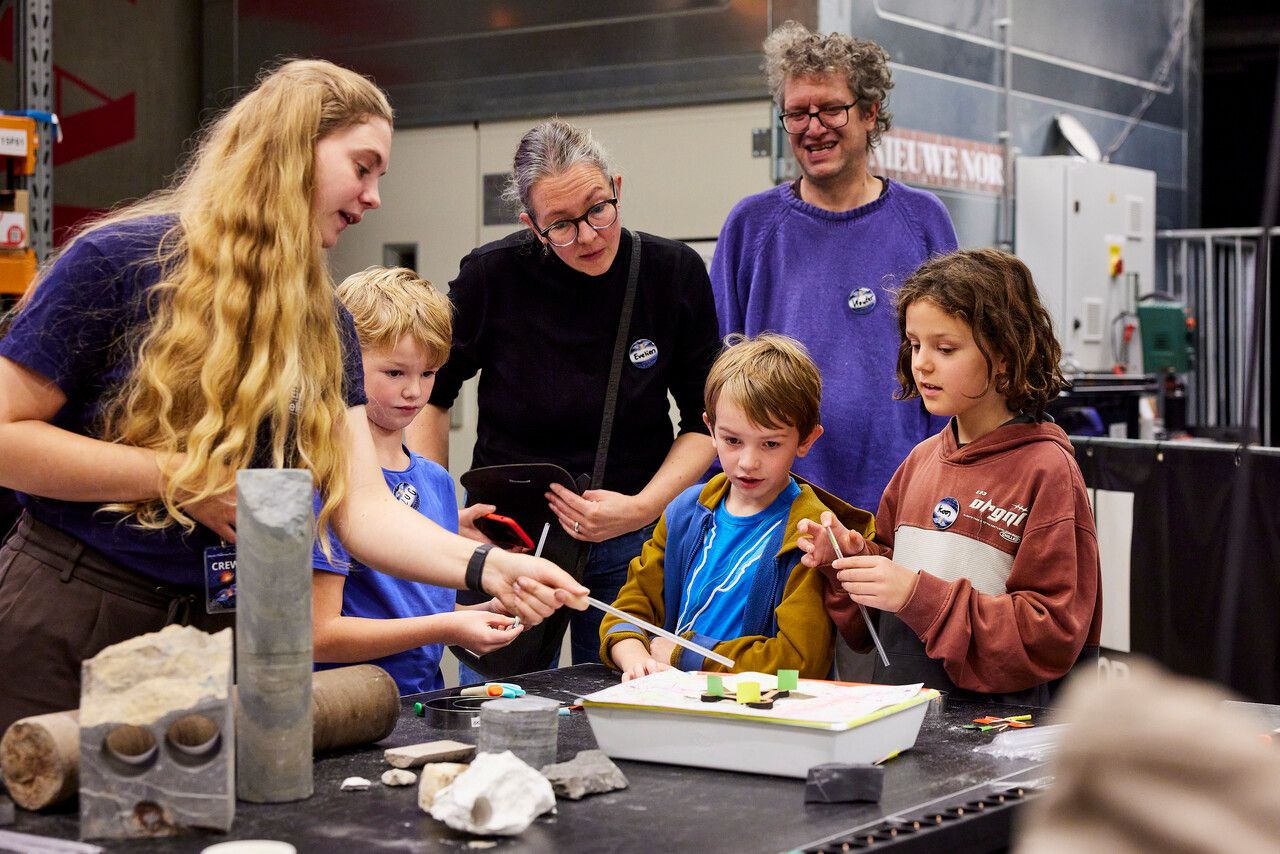 Foto: Provincie Limburg