
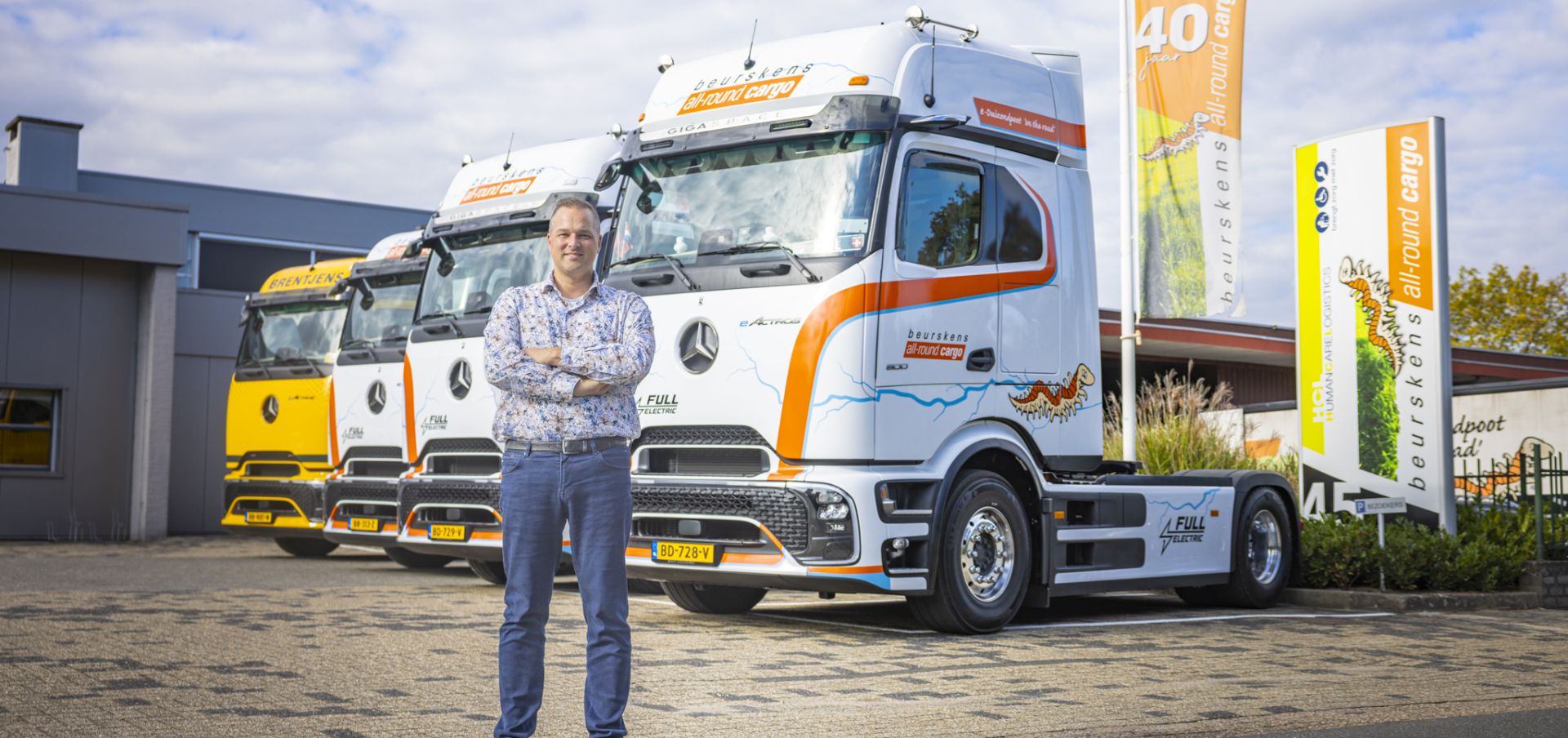
 Foto: Logistiek Bereikbaar
Beurskens Allround Cargo BV heads to Switzerland with e-trucks
28 October | Duurzaam | Logistiek Bereikbaar
From now on, two electric lorries will be operating on the Limburg–Switzerland route for Beurskens Allround Cargo BV. The two e-lorries replace two diesel lorries that previously operated on this route. “Driving electric saves us 25,000 euros in tolls per lorry, per year,” says director Sander Knoben. And there are further benefits. A fine example of smart and sustainable business in Limburg!
Electric transport is nothing new for the haulage firm based in Tegelen. The company already operates electric vehicles for Brentjens building materials and for DHL Freight in Eindhoven. Since the end of October 2026, two electric lorries have been added to the fleet for deliveries to Switzerland. These routes were previously served by two diesel lorries. In December 2025, director Sander Knoben drove to Switzerland himself in an electric lorry as a trial. “It went very well and that was the deciding factor for me in purchasing two electric lorries for this route.” Sander’s enthusiasm rubbed off on his colleagues: before long, two drivers approached Sander, keen to drive the e-lorry to Switzerland.

Combining rest and recharging
And so, every week, two Mercedes-Benz eActros 600 electric lorries are now heading south. Driving such a distance on electric power means the company has to plan a bit further ahead. Sander: “Previously, the driver decided for themselves where to refuel and take a break. Now we want to combine charging with rest stops. That’s why our planners are looking at where along the route it makes sense to do this. Not every charging point is the same. At some charging stations, you can drive in with your trailer, whilst at other locations the driver will first have to uncouple the trailer. So, over the coming period, it’s also a bit of a process of discovery to find out which are the best charging locations for us.”
Driving Hours Act
The Driving Hours Act is largely well suited to the charging requirements of an electric lorry. “The law states that after 4.5 hours’ driving, you must take a 45-minute break. An electric lorry can easily drive for 4.5 hours at a stretch. And during that 45-minute break, the battery can be largely recharged,” says Sander. Things get trickier after the next 4.5 hours’ driving. “Then there’s a mandatory rest period of at least nine hours. You’ll want to recharge the truck then too. But if the driver has to move the truck during that rest period because someone else wants to load it, this is not permitted under the Driving Times Act. Situations like that are obviously inconvenient; legislation will need to be introduced to address this in the future.”
Lobby for an exemption
Sander is therefore lobbying, together with organisations such as TLN, for an amendment to the Driving Times Act to cover situations of this kind. “You see a similar situation in the port. There, a driver is allowed to move his lorry twice whilst resting, if necessary. We would also like to see such an exception in the Driving Times Act when it comes to charging an electric lorry.”
Full on the way there, full on the way back
The e-trucks set off on Monday mornings and arrive in Switzerland by the evening, just as the diesel lorries used to. After their rest period, the lorries continue on their way to deliver their load and collect a new one. “Sometimes we have a full load for a single address; sometimes the drivers visit two to four addresses.” The lorries certainly don’t return to Limburg empty. “We almost always have a return load. And if we don’t, we take a return load from our partner company in southern Germany. The trailers always return to Limburg fully loaded.”
Saves 25,000 euros in tolls per lorry per year
A major advantage of the two electric lorries is that no tolls or LSVA charges need to be paid in Germany and Switzerland. “And that saves us a fair bit of euros,” says Sander. “In Germany, we used to pay 0.35 euros per kilometre in tolls with our diesel lorries, and in Switzerland as much as 1 euro per kilometre. Driving electric vehicles saves us 25,000 euros in tolls per truck each year. As a result, we’ve recouped the additional purchase cost in four or five years.”
Costs for diesel vehicles are rising
And Sander sees even more areas where electric lorries offer better value for money than diesel ones. “Take the lorry toll, for example, where you pay less for electric vehicles than for diesel ones. And the costs for the maintenance contract on our e-lorries are also lower than those for our diesel ones. Not to mention the current sky-high diesel prices.” Electric driving provides the company with an additional financial benefit, as it makes use of EREs. These are tradable certificates that allow you to earn money for every kWh charged. “Hopefully, thanks to these EREs, we’ll be charging for just a quarter per kWh.”
Even more electric lorries
The two e-trucks on the route to Switzerland are not the first electric lorries for Beurskens Allround Cargo. Since August 2025, the company has also been operating an electric lorry for Brentjens building materials from Haelen (near Roermond). The haulier also operates electric lorries for DHL. “This e-truck spends around 12 to 13 hours a day travelling back and forth between North Limburg and Eindhoven,” says Sander.
Charging
Do all four electric lorries charge in Tegelen? “No, Brentjens’ e-lorry charges at Brentjens’ premises,” says Sander. “DHL’s e-lorry does, however, plug into the charging point here overnight. Unfortunately, we have a limited mains connection, which means the e-truck has to be connected to the charging point for at least 10 hours to fully charge the battery.”
The charging point has two charging sockets. The electric lorries from Switzerland will return on Friday evening; they’ll be plugged in on Saturday and Sunday. So it’ll just about work. As the company won’t be stopping at four electric lorries, it’s on the waiting list for a larger electricity supply. And in the meantime, Sander is looking into temporary solutions to increase the power supply. “For example, we’re looking into whether we can use power from our neighbour via cable pooling.”
Grants: AanZET and SPRILA
To make the financial package even more attractive, Beurskens made use of grants. The company was awarded the AanZET grant for the purchase of all the electric forklift trucks. And for the purchase of the charging point, it received the SPRILA grant. For business owners who are also interested in these grants: AanZET will be available for applications again in 2027. And SPRILA is still open for applications until 18 December 2026.
Advice from a logistics broker
When making the switch to his first electric lorry, Sander received advice from logistics consultant Mark Luikens of Logistiek Bereikbaar. Sander: “To make that transition smoother, Mark, for example, put us in touch with the local council, Enexis and charging point suppliers. He also helped us with TCO calculations, grants and practical queries. Mark’s advice is very pleasant and informal. He has a knowledgeable perspective.”
Get free advice
Is your company also looking to transition to an electric fleet, but you’re not quite sure where to start? Mark and his colleagues would be happy to advise your company too. They can carry out a TCO calculation for you, comparing the bottom-line costs of your current diesel vans or lorries with those of electric alternatives. They can also advise you on which charging points would be best suited to your business and what capacity your electricity supply will need to be in the future to enable you to charge your entire fleet on-site.
Personal logistics advice