
 © TracXon
12 August | Innovatief | Octrooicentrum Nederland
At TracXon, patents are brought to life in concrete products
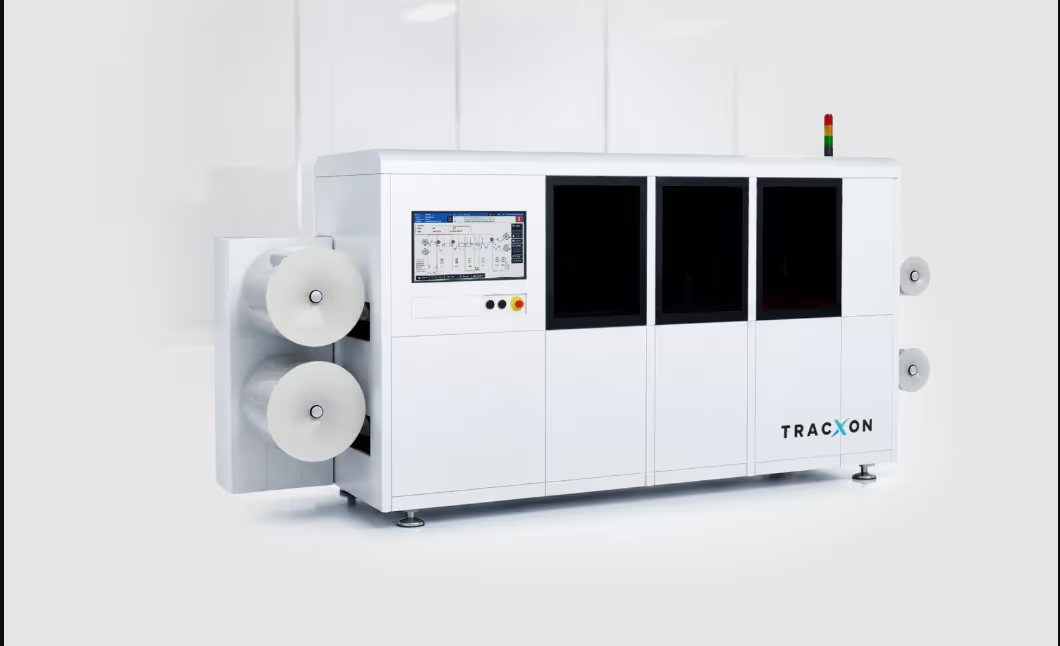
During Innovation Day on 25 June, TracXon unveiled an eight-metre-long machine for the production of flexible printed circuit boards (PCBs). Behind this prototype lies a process of development, adaptation and intellectual property (IP) protection. This gives TracXon and its customers a competitive edge.
TracXon, a start-up founded in 2022, develops machines for the production of printable electronics. The company originated from TNO, where a so-called roll-to-roll process was developed to print on thin, flexible circuit boards. These circuit boards are used in applications such as battery systems, smart packaging and wearables.
TracXon built on this and developed its own technology within a short space of time. Whilst the company initially relied on TNO’s expertise and patents, it now has its own portfolio of four patents. “We have grown from a company that was dependent on TNO’s intellectual property to a business with its own technological foundation,” says CEO Ashok Sridhar. “With four new patents, we have further expanded our expertise in the field of process innovation and machine development.”
Exclusivity or market penetration?
As the Holst Centre collaborates with many partners in open innovation programmes, a large proportion of the knowledge developed is jointly owned. Consequently, that technology cannot simply be transferred to a single company.
TracXon therefore initially opted for non-exclusive licences for the necessary patents and also entered into an option agreement for several patents. “We started out as a manufacturing company. At that stage, we didn’t need exclusive rights, but above all the freedom to use the technology,” says CEO Ashok Sridhar. “We had the option to acquire the intellectual property rights on an exclusive basis, but that was not financially viable. Moreover, TNO could not simply transfer that knowledge on an exclusive basis, as part of it had been developed using public funds.”
TracXon has since acquired the relevant patents from TNO in return for payment.
Expertise can make a big difference
It wasn’t just about the cost of exclusive rights, Sridhar emphasises. “In printed and flexible hybrid electronics, many processes come into play simultaneously. At the time, we didn’t yet know which aspects of intellectual property would ultimately make the difference. We therefore had to maintain control over the entire process.”
Sridhar and co-founders Corne Rentrop and Raghu Kishore Pendyala were themselves closely involved in developing that expertise at TNO. As well as patents, they also brought a wealth of practical expertise with them. According to the CEO, that know-how was crucial in the company’s early stages. “That knowledge was key to our early commercial success. It meant we were able to get started without having full control over the intellectual property from day one.”
At the same time, patents are costly, particularly for a start-up. Not only does applying for them cost a lot, but maintaining them across different regions is also expensive. Yet they are often essential for attracting investors and customers. “As a founder, you’re caught between two realities: a patent doesn’t change your business overnight, but without patents it’s difficult to secure funding. That tension is very real,” he says.
Deciding what to patent
The founders — Pendyala, Rentrop and Sridhar — agreed on the company’s first three patent applications. They received support from the Netherlands Patent Centre in this regard. TracXon subsequently developed a so-called stage-gate process to determine which ideas should and should not be patented.
“Roll-to-roll production for Internet of Things devices and wearables has now become our most important market segment,” says the CEO. “That is why we assess every idea against that strategic focus. We also check whether it is technically viable and truly distinctive.”
Not every idea is immediately developed into a patent. Ideas that are still too early-stage are stored in what is known as an ‘idea vault’: a digital register that employees sign when they submit a new concept. This ensures that the company retains its rights, even if an idea is not yet ready for a patent application.
If a concept is developed further, it may still come to play a role in the company’s strategy. And staff are also allowed to continue working on ideas that are ultimately rejected.
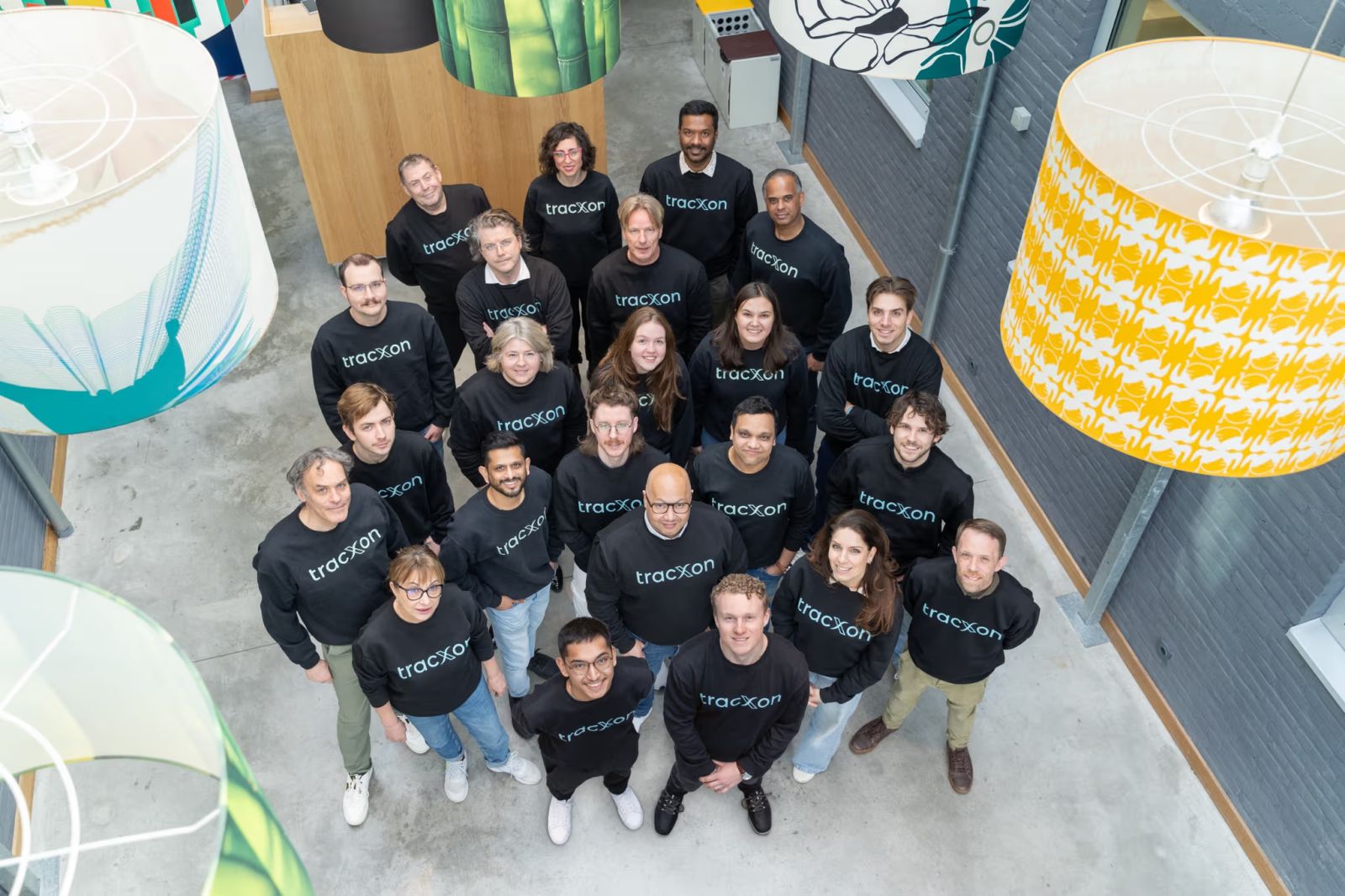 Het team van TracXon - © TracXon
How intellectual property makes a difference
According to Sridhar, the recently granted patents will be clearly evident in the printing press that TracXon is set to launch shortly. Some of the innovations have been incorporated directly into the machine, whilst others are reflected in the products produced by it.
A frequently asked question is whether Chinese competitors could quickly copy the company. Given China’s strong position in electronics manufacturing, that is not an unreasonable concern, says the CEO. But he believes there are sufficient safeguards in place.
“Those two patents associated with our machine are my answer,” he says. “Smart competitors may well have good ideas elsewhere, but they cannot replicate exactly what we do. You can see that in the printed circuits. That is precisely where our value lies: customers can create unique, patentable products.”
Managing patents sensibly
Finally, Sridhar offers some practical advice to start-ups. “Carefully assess what you can afford, not just now but also over the next two years,” he says. “There’s no point in applying for patents just for the sake of it.”
With a growing pipeline of ideas and the first generation of machines on the horizon, TracXon is looking to the future with confidence. Intellectual property is increasingly becoming the company’s key differentiator.
This article was produced in collaboration between Octrooicentrum Nederland and the editorial team at IO+, an independent journalism platform.